

 Book An Appointment


Updated Glenoid fracture repair with Remplissage in High Level Quarterback
Dr. Garcia specializes in complex knee, shoulder and elbow sports surgeries. He has prepared a number of surgical videos below to help patients better understand their procedures. He is frequently updating his surgical video database so check back soon for further updates.
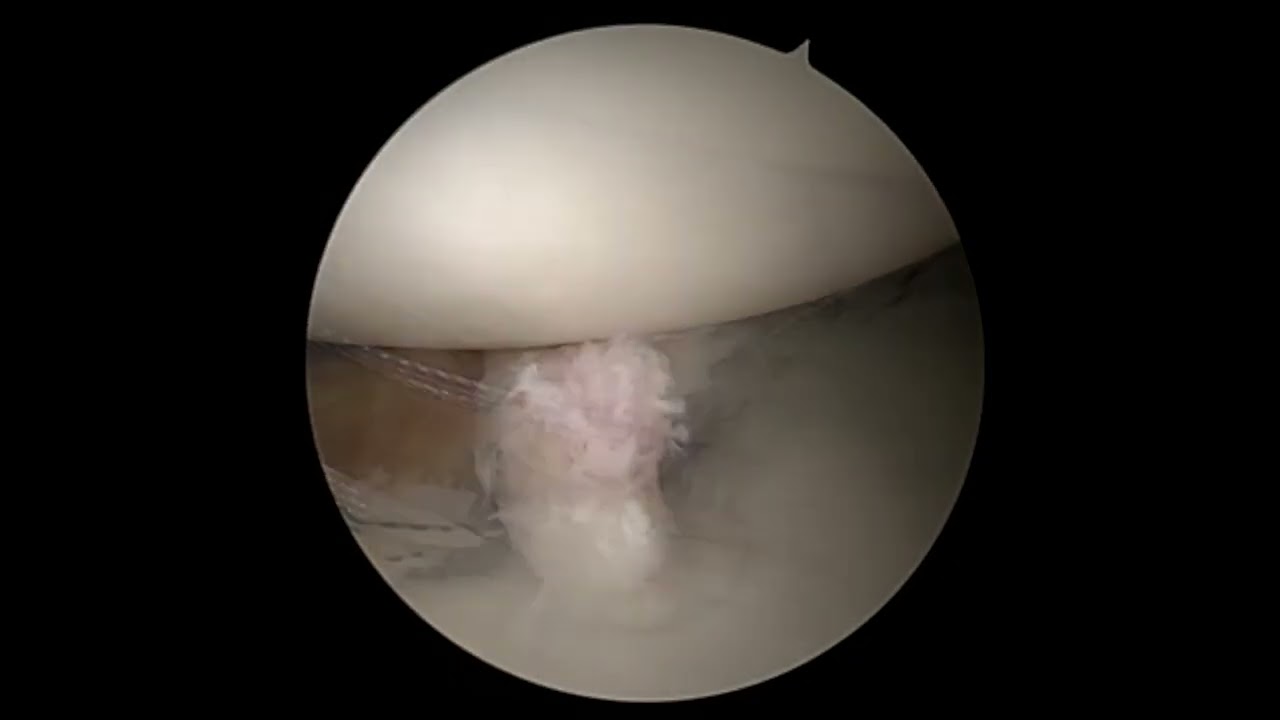
This video demonstrates Dr. Grant Garcia’s advanced arthroscopic technique for a glenoid fracture repair with a concurrent Remplissage procedure. This operation is performed on a young quarterback presenting with a highly unusual, displaced "parrot-beak" anterior labral tear attached directly to a loose bone fragment, alongside an engageable Hill-Sachs lesion on the back of the arm bone.
Rather than excising the fragment—which would leave almost no functional labrum—Dr. Garcia chose to preserve all native cartilage and bone to maintain the solid structural "bumper" needed for throwing mechanics.
The complex procedure is executed through the following key surgical steps:
- Site Assessment & Preparation: Dr. Garcia first uses an arthroscopic probe to evaluate the highly mobile "parrot-beak" fragment. He notes that the bone underneath has exposed cartilage where the piece was pulled away. He carefully debrides the bone bed to create a raw, bleeding footprint to induce biological bone-to-bone healing, ensuring the piece isn't damaged or separated from its labral attachments.
- Managing the Displaced Fragment: Because the fragment has been displaced for a couple of weeks, it is constantly twisting, shifting, and trying to curl back into the joint gutter during instrumentation. Dr. Garcia utilizes multiple surgical portals and a two-handed technique—using one device to push and tuck the piece under the native labrum while passing sutures with the other.
- Sequential All-Knotless Hammock Fixation: Using a modern labral kit featuring color-coded, knotless FiberTack anchors, Dr. Garcia strategically maps out his fixation. A rotational suture lasso is used to take precise tissue bites through the capsule and the mobile fragment. He places a sequence of four knotless anchors around the defect. The distinct suture colors allow for clear line management through a single cannula. The anchors are incrementally cinched down without knots, forming a secure structural hammock that reduces the fracture and compresses the labrum flush against the glenoid rim.
- Concurrent Remplissage Procedure: After reconstructing the front of the joint, Dr. Garcia addresses the posterior Hill-Sachs defect (the bone dent caused by dislocations). He performs a Remplissage, inserting anchors into the humeral defect and capturing the overlying infraspinatus muscle and joint capsule.
The final visualization shows that the knotless anchors have been fully tensioned, pulling the infraspinatus tendon flat into the Hill-Sachs cavity to "fill" the dent. Combined with the perfectly reconstructed, high-volume anterior labral bumper, this dual-stabilization construct completely eliminates joint volume redundancy to safely restore global shoulder stability.