

 Book An Appointment


In The News
HISTORY MADE! THE FUTURE OF REMPLISSAGE IS HERE!
Post:
🚀 HISTORY MADE! THE FUTURE OF REMPLISSAGE IS HERE!
Today, we performed the FIRST TWO remplissage cases in the United States
using the NEW Arthrex Remplissage Implant System! 🔥
After 2 years of design, refinement, patents, and collaboration with
Arthrex, seeing this technology go from an idea to the operating room was
an incredible moment.
💥 And the results were immediate.
Even with my extensive experience performing remplissage procedures, this
new system allowed us to:
✅ Reduce surgical time by approximately 15 minutes
✅ Improve precision and control
✅ Simplify a technically demanding procedure
And this was only our FIRST DAY using the final system!
👏 Innovation takes a team.
A huge shoutout to Stephan Bosch* , the Arthrex engineer* who was
instrumental in co-designing this cannula with me. Seeing him in the OR for
these first cases made this milestone even more special.
Special thanks to Rachel Robinson my incredible Arthrex rep, Vaid
Olanday, and my rock-star PA Corbin Brokaw, PA-C for helping make this
launch a success!
From an idea on a napkin to a patented surgical innovation now being used
in patients - this is why I love what I do.
🔥 The future isn’t coming. It’s already here.
I can’t wait for surgeons across the country to experience what this new
technology can bring to shoulder instability surgery.
This is just the beginning. 🚀
Final teaser, live video technique coming shortly….
Real sports medicine conversations. Hosts Orthopedic Surgeon Dr. Grant Garcia & Will Sanchez
Post:
Why Are Hamate Fractures Spiking in Baseball?
Why are hand injuries suddenly spiking in modern baseball? ⚾️
Dr. Nicholas Rose explains how the modern emphasis on power hitting may be
changing the mechanics at the plate.
As players drop their hands lower on the knob of the bat, the “Palmar
hamate grip” can increase pressure over the hook of the hamate - a small bone
that can become a major problem for a hitter.
A fascinating look at how changes in technique can create new injury
patterns in elite sports.
🎥 Watch the short:
https://www.youtube.com/shorts/_aKOzrgqgfo
*🎧 Listen to the full episode: *Spotify - Full Episode
Follow / connect:
Nicholas Rose, MD
William Sanchez
Grant Garcia, MD
#SportsDocTalk #BaseballInjuries #PowerHitting #HamateFracture
#Orthopedics #SportsMedicine
Brought to you by The Recovery Shop - your go-to for post-surgical rehab
and DME solutions.
For more information, contact Mike at mikeb@shop-recovery.com.
Nutrition 28: Inflammation after Surgery
Post:
🔥 Inflammation After Surgery: More Isn’t Always Better
Inflammation gets a bad reputation-but we actually need it to heal. 🩹
The problem is balance.
✅ Normal inflammation supports tissue signaling, collagen formation & immune defense
⚠️ Excessive inflammation can increase pain, impair muscle recovery & potentially slow healing.
Nutrition can help support that balance:
🐟 Omega-3s
🫐 Polyphenol-rich foods
😴 Sleep-supportive nutrition
🍷 Limit excessive alcohol
💊 Many patients reach for NSAIDs because they’re a non-opioid option for pain and inflammation. But depending on the procedure and healing tissue, more suppression isn’t always better.
Sometimes the better strategy is understanding inflammation-and getting ahead of it.
🎥 Video 28: Inflammation - The Balance Problem
Full Surgical Nutrition Series: https://www.grantgarciamd.com/nutrition-shoulder-knee-sports-surgeon-seattle-bellevue-everett-kirkland-wa.html
Dr. Garcia’s newest invention the cutting edge remplissage technique
Post:
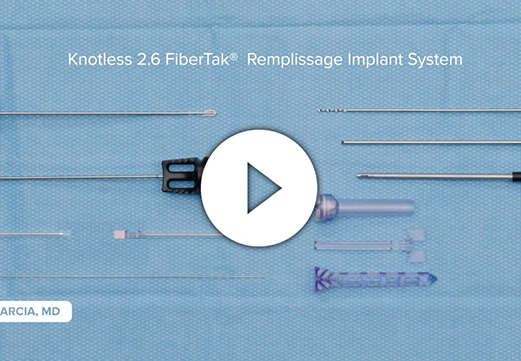
🚀 FROM A NAPKIN SKETCH TO REALITY - THE FUTURE OF REMPLISSAGE IS HERE!
Two years. Countless prototypes. Patents. Collaboration. And now, it’s a reality.
I’m incredibly proud to announce the official launch of the Arthrex Knotless FiberTak® Remplissage Implant System, a system I had the privilege of co-designing with the incredible team at Arthrex.
This moment is particularly special.
In 2012, as a medical student at the University of Pennsylvania, one of my first research papers was on remplissage with John Kelly
Nearly 15 years later, I’ve gone from studying this procedure to helping redesign how surgeons perform it.
What started as a sketch on a napkin evolved through two years of engineering, patents, prototypes, and relentless refinement into a system designed to make remplissage faster, simpler, and more reproducible.
🔹 Purpose-built instrumentation
🔹 Streamlined surgical workflow
🔹 Knotless, tensionable fixation
🔹 Designed by surgeons, for surgeons
Why is this such a big deal?
Remplissage is increasingly being called “the LET of the shoulder.”
Just as lateral extra-articular tenodesis has changed the conversation around ACL surgery, remplissage is transforming how we approach shoulder instability.
With growing clinical evidence supporting its role and now a system designed to simplify the technique, I believe we’re entering a new era of shoulder stabilization.
The question surgeons should increasingly be asking isn’t just “When should I perform remplissage?”
It’s “Why am I NOT performing remplissage in the appropriate patient?”
A huge thank you to the engineers, product development teams, and surgeons at Arthrex who helped bring this vision to life.
Innovation isn’t just about developing new technology. It’s about making great surgical techniques easier to perform and more accessible to surgeons and their patients.
From medical student research to a patented surgical system - this is one of the most rewarding full-circle moments of my career.
The future of remplissage is here. And we’re just getting started.
🎥 See the new system in action:
Rare meniscal root pattern with repair.
Post:
NOT YOUR TYPICAL MENISCUS ROOT TEAR. **🦵🔬
My newest surgical technique video highlights the versatility of SutureLoc in a medial meniscus root tear that was anything but routine.
In this case, only the posterior half of the medial meniscus was separated from the root, creating an unusual partial root tear pattern and adding a level of complexity I don’t commonly encounter.
Rather than treating this like a standard complete root avulsion, the repair needed to capture and restore the detached portion while preserving the fibers that remained intact.
🔹 Unique partial medial meniscus root tear
🔹 Posterior 50% detached with remaining root fibers intact
🔹 SutureLoc repair adapted to the tear pattern
🔹 Preservation of the intact native tissue
🔹 Performed in combination with an ACL reconstruction
This is where having a versatile repair system becomes particularly valuable-the technique can be adapted to the actual anatomy of the tear rather than forcing every root tear into the same construct.
🎥 Check out the full technique video to see how I approached this unusual pattern step-by-step.
Hopefully, sharing cases like this gives other surgeons another option when they encounter a root tear that doesn’t look like the textbook version.
Preserve what is intact. Repair what is torn. Restore the root.
Real sports medicine conversations. Hosts Orthopedic Surgeon Dr. Grant Garcia & Will Sanchez
Post:
Same Fracture, Two Very Different Treatments
Why can the exact same broken bone require two completely different treatments? 🦴
Dr. Nicholas Rose explains the decision-making behind treating a hook of the hamate fracture.
A 17-year-old athlete may be treated in a cast. For a professional player, however, prolonged casting can mean losing a major portion of the season-and the hook of the hamate may still fail to heal because of its limited blood supply.
Age, level of competition, healing potential, and the cost of time away from sport can all change the treatment discussion.
*🎥 Watch the short: *https://www.youtube.com/shorts/H-M_VeBrkAE
*🎧 Listen to the full episode: *Spotify - Full Episode
Follow / connect:
Nicholas Rose, MD | https://www.linkedin.com/in/nicholasrose1214/
William Sanchez | https://www.linkedin.com/in/willsancheznyc/
Grant Garcia | https://www.linkedin.com/in/grant-garcia-29127322/
Brought to you by The Recovery Shop - your go-to for post-surgical rehab and DME solutions.
For more information, contact Mike at mikeb@shop-recovery.com
Nutrition 27: Staying on a GLP-1 After Surgery?
Post:
Staying on a GLP-1 After Surgery? Nutrition Can’t Be an Afterthought.
If appetite is suppressed, don’t rely on hunger to tell you when to eat.
My key strategies:
→ Liquid protein when meals are difficult
→ Protein every 3–4 hours
→ Essential amino acids when intake is limited
→ Calorie-dense, high-quality foods
→ Monitor weight and strength
Rapid weight loss after surgery may mean losing muscle-not just fat.
Bottom line: GLP-1s and surgical recovery can coexist, but nutrition needs to be intentional.
🎥 Watch Video 27 for the strategy.
Full Surgical Nutrition Series: https://www.grantgarciamd.com/nutrition-shoulder-knee-sports-surgeon-seattle-bellevue-everett-kirkland-wa.html
Chapter 41. Couldn’t ask for a better start! 🎂🌊
Post:
Chapter 41. Couldn’t ask for a better start! 🎂🌊
What an incredible birthday weekend! A reminder that the best things in life aren’t things at all.
❤️ A wonderful dinner with my wife and best friend.
🌊 An early morning wakesurf session in 57°F water-because why not?
🎂 A special birthday celebration with my two amazing daughters.
🐶 And our first weekend with Salty, our newest family member-an 8-week-old Australian Labradoodle who’s already stolen our hearts!
Life moves fast, and between work, family, and everything in between, weekends like this remind me what matters most.
41 years in, and I wouldn’t change a thing. Grateful for the life we’ve built, the people I get to share it with, and all the adventures still ahead.
Here’s to another year of making memories, chasing new challenges, and enjoying every moment along the way!
Life is good. ❤️🌊🐾
Post:
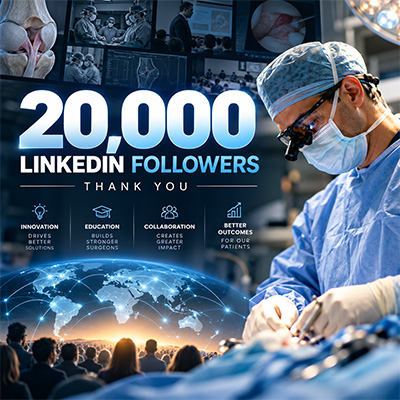
🚀 20,000 FOLLOWERS. ONE MISSION: PUSH THE BOUNDARIES OF ORTHOPEDIC SURGERY.
When I started sharing my surgical techniques, challenging traditional approaches, and highlighting new technologies, I never imagined reaching 20,000 professionals on LinkedIn.
But this milestone represents something bigger than a number.
🔬 Innovation matters. From ACL repair and complex meniscus transplantation to cartilage restoration and shoulder instability, I believe we should never stop questioning how we can improve outcomes.
🏥 Education drives progress. Sharing real surgical cases, technical challenges, successes, and even setbacks helps all of us become better surgeons.
💡 The future of orthopedics is being built TODAY. Through research, collaboration, and a willingness to challenge the status quo, we can continue advancing what’s possible for our patients.
I’m incredibly grateful to the surgeons, researchers, industry partners, patients, and colleagues who have joined me on this journey.
20,000 followers isn’t the finish line. It’s motivation to keep pushing forward.
More surgical innovations. More education. More collaboration. And most importantly, better options for our patients.
🙏 THANK YOU FOR 20K!
Let’s keep advancing orthopedic surgery together.
Reaching the tibial plateau solving an impossible graft
Post:
Reaching the Tibial Plateau: Solving an “Impossible” Graft
How do you fix a joint when the bones themselves are in the way? 🛑
The new episode of Sports Doc Talk is LIVE. Dr. Travis Maak joins us to discuss refusing to accept “impossible” in the OR.
For years, transplanting cartilage on the tibial plateau was considered exceptionally difficult because the femur blocks access. Dr. Maak describes partnering with biomechanical engineers to develop custom instrumentation designed to bypass that barrier and reach the injury.
It’s a great example of what happens when a clinical problem drives surgical innovation.
🎧 Listen to the full conversation on Spotify:
Spotify - Full Episode
*🎬 Featured clip: *https://www.youtube.com/shorts/AijMeHj2OZ0
Follow / connect:
Travis Maak | https://www.linkedin.com/in/travis-maak-09541a18/
William Sanchez | https://www.linkedin.com/in/willsancheznyc/
Grant Garcia | https://www.linkedin.com/in/grant-garcia-29127322/
Brought to you by The Recovery Shop - your go-to for post-surgical rehab and DME solutions.
For more information, contact Mike at mikeb@shop-recovery.com
Nutrition 26: GLP-1s + Surgery: Are You Under-Fueling Your Recovery?
Post:
GLP-1s + Surgery: Are You Under-Fueling Your Recovery?
GLP-1s can be incredibly effective-but after surgery, appetite suppression may work against recovery.
Less food can mean:
→ Less protein
→ More muscle loss
→ Less fuel for rehab
→ Slower recovery
Surgery is a catabolic state. Your body needs calories and protein to heal, preserve muscle, and rebuild strength.
The goal isn’t to stop GLP-1 therapy-it’s to make sure weight loss doesn’t come at the expense of recovery.
🎥 Watch the video for what patients taking GLP-1s should consider after surgery.
More from my Surgical Nutrition Series: https://www.grantgarciamd.com/nutrition-shoulder-knee-sports-surgeon-seattle-bellevue-everett-kirkland-wa.html
Dr. Garcia’s latest technique for elbow arthroscopy and OCD treatment
Post:
ELBOW ARTHROSCOPY: SETUP MATTERS. **💪🔬
My newest surgical technique video walks through my TriMano arm-holder setup for elbow arthroscopy-from positioning all the way through the full procedure.
In this case, we’re treating a young athlete with an elbow osteochondritis dissecans (OCD) lesion.
The TriMano setup provides controlled positioning of the arm throughout the case while maintaining the access and flexibility needed for arthroscopic treatment.
🔹 Step-by-step TriMano positioning and setup
🔹 Portal placement and arthroscopic evaluation
🔹 Identification of the OCD lesion
🔹 Arthroscopic removal of the unstable OCD fragment
🔹 Assessment of the remaining joint and cartilage
For young athletes, the goal isn’t simply to remove the symptomatic lesion. It’s to treat the pathology while minimizing surgical morbidity and creating the best opportunity for a safe return to sport.
And the best part of this case?
This athlete was able to get back quickly to the sport they love. **🙌
🎥 Check out the full technique video to see the setup and procedure from start to finish.
Great surgery starts before the first incision.
https://www.grantgarciamd.com/elbow-osteochondritis-dissecans-surgery.html
Remplissage in a Thrower - Innovation Starts Here
Post:
🏈 REMPLISSAGE IN A THROWER - INNOVATION STARTS HERE.
One of the toughest challenges in shoulder instability surgery? Elite throwing athletes.
When a high-level quarterback presented with shoulder instability and a Hill-Sachs lesion, we faced a difficult decision.
🔹 Standard Bankart repair: Approximately 7–10% recurrence, potentially higher in contact athletes.
🔹 Bankart + Remplissage: Recurrence rates as low as 3% in selected studies, but limited data in elite throwers and concerns about throwing mechanics.
Our goal wasn’t just stability. It was getting him back to throwing at the highest level.
After extensive discussions with my patient and his family, we made the decision TOGETHER to pursue remplissage-with a modification.
Drawing on my experience with shoulder instability surgery and Arthrex technology, I modified the infraspinatus fixation point to create a steeper trajectory, aiming to preserve throwing mechanics without sacrificing stability.
I call it “Remplissage Minus” - a modified technique for throwers.
The comeback?
🔥 Back as the STARTING QUARTERBACK.
🔥 One of Washington State’s top-ranked QBs.
🔥 Leading his team to a 5–1 record.
Last Friday, I drove 30 minutes through the Washington rain to watch him play.
And it did NOT disappoint. 🏈
Seeing him back on the field after months of hard work was incredible.
Innovation isn’t always about reinventing surgery. Sometimes it’s about modifying what works to meet the demands of an exceptional athlete.
Congratulations on an amazing comeback! Thank you to my patient and his family for trusting the process and allowing us to push the boundaries of return to sport.
More to come on remplissage, innovation, and this story!
Posted with patient and family permission. Individual results vary; further research is needed in elite throwers.
Why injury prevention is the wrong phrase
Post:
Why “Injury Prevention” May Be the Wrong Phrase
Is “injury prevention” the right way to talk about injuries in elite athletes? ⚠️
In our conversation with Dr. Travis Maak, we discuss why “injury mitigation” may be a more accurate framework.
When an athlete straps on skis or steps onto the court, pushing physical limits is fundamental to the job. Calling every injury preventable can imply that getting hurt represents a failure by the athlete or medical team.
The better question: how do we understand risk, manage workload, and reduce the likelihood or severity of injury without pretending risk can be eliminated?
🎧 Catch the full Sports Doc Talk episode on Spotify:
Spotify - Full Episode
*🎬 Featured clip: *https://www.youtube.com/shorts/RWRCBOEP_Qg
Follow / connect:
Travis Maak | https://www.linkedin.com/in/travis-maak-09541a18/
William Sanchez | https://www.linkedin.com/in/willsancheznyc/
Grant Garcia | https://www.linkedin.com/in/grant-garcia-29127322/
Brought to you by The Recovery Shop - your go-to for post-surgical rehab and DME solutions.
For more information, contact Mike at mikeb@shop-recovery.com
Nutrition 25: PEPTIDES: IT’S NOT JUST “DO THEY WORK?”
Post:
⚠️ PEPTIDES: IT’S NOT JUST “DO THEY WORK?”
The peptide market is exploding. 🧬📈
But marketing has moved much faster than the evidence.
Before using a peptide, there are bigger questions:
🧪 What’s actually in the product?
💉 Is the dose and purity reliable?
⚠️ What safety data actually exists?
🏆 And for athletes-*is it banned?*
Many peptides promoted online for healing or performance are not FDA-approved for those uses, and FDA has raised safety concerns about certain substances used in compounding.
For competitive athletes, the stakes are even higher. 🚨
WADA prohibits multiple peptide hormones, growth factors and related substances-including several commonly discussed in the performance and recovery world.
🎯 Bottom line: “available online” does NOT mean proven, safe, approved-or permitted in competition.
Patients and athletes deserve to know the science AND the rules.
🎥 Video 25: Peptide Therapy - Regulation, Safety & Athlete Considerations
https://youtube.com/shorts/u3ujibjA-kE
Full Surgical Nutrition Series: https://www.grantgarciamd.com/nutrition-shoulder-knee-sports-surgeon-seattle-bellevue-everett-kirkland-wa.html
Updated Meniscal Root Repair with Centralization Stitch
Post:
MENISCAL ROOT REPAIR IS EVOLVING. **🦵🔬
My newest surgical technique video demonstrates a medial meniscus root repair using SutureLoc-combined with a centralization stitch using an Arthrex FiberStitch.
Why add the centralization?
A root tear doesn’t just detach the meniscus-it can allow the meniscus to extrude outside the joint, compromising its ability to distribute load and protect the cartilage.
🔹 SutureLoc - Anatomic fixation of the medial meniscus root
🔹 FiberStitch centralization - Helps address the extruded meniscus and restore its position over the tibial plateau
🔹 The goal - Repair the root AND address the extrusion rather than treating the root tear alone
The emerging data are compelling. Biomechanical studies demonstrate improved meniscal mechanics with centralization, and recent clinical studies suggest it can reduce or limit progression of meniscal extrusion. The long-term clinical advantage over isolated root repair is still being defined.
This has changed my practice.
For isolated medial meniscus root tears with significant extrusion, I now add a centralization stitch in approximately 50% of my cases.
It’s another example of how meniscus surgery is moving beyond simply “fixing the tear” toward restoring the anatomy and biomechanics of the entire meniscus.
🎥 Check out the new technique video to see the SutureLoc + FiberStitch centralization construct in action.
How the NBA used data to stop Achilles spikes
Post:
How the NBA Used Data to Address Achilles Injury Spikes
Why did the NBA suddenly see a massive spike in Achilles tears? 🏀
On Sports Doc Talk, Dr. Travis Maak takes us behind the scenes of how the league brought experts together to examine the problem.
The discussion explores analytics, video motion capture, workload, and the physical thresholds elite athletes face across an NBA schedule-and why load management is more than a buzzword.
🎧 Listen to the full conversation on Spotify:
Spotify - Full Episode
🎬 Featured clip: https://www.youtube.com/shorts/yTWOvKziVcY
Follow / connect:
Travis Maak | https://www.linkedin.com/in/travis-maak-09541a18/
William Sanchez | https://www.linkedin.com/in/willsancheznyc/
Grant Garcia | https://www.linkedin.com/in/grant-garcia-29127322/
Brought to you by The Recovery Shop - your go-to for post-surgical rehab and DME solutions.
For more information, contact Mike at mikeb@shop-recovery.com
Nutrition 24: Peptides - What Does the Evidence Actually Say?
Post:
🧬 PEPTIDES IN ORTHOPEDICS: EXCITING SCIENCE-BUT ARE WE THERE YET?
Peptide therapy is one of the fastest-growing trends in regenerative orthopedics. 📈
The theory is compelling:
🦵 Tendon repair
💪 Muscle regeneration
🔥 Inflammation modulation
🧬 Biologic signaling for healing
But here’s the important part:
🔬 Most evidence remains preclinical
❌ No injectable peptides are currently FDA-approved for orthopedic use
❓ Optimal dose, timing & frequency remain undefined
📊 We still need high-quality randomized clinical trials
My approach: cautious optimism.
Follow the science. Understand the potential. But don’t confuse an exciting biologic concept with a proven clinical treatment. 🎯
🎥 Video 24: Peptides - What Does the Evidence Actually Say?
📚 Reference: Mayfield CK, Bolia IK, Feingold CL, et al. Injectable Peptide Therapy: A Primer for Orthopaedic and Sports Medicine Physicians. American Journal of Sports Medicine. 2026;54(1):223-229.
Full Surgical Nutrition Series: https://www.grantgarciamd.com/nutrition-shoulder-knee-sports-surgeon-seattle-bellevue-everett-kirkland-wa.html
2nd look after lateral dovetail meniscus transplant
Post:
Updated to make the dovetail technique a key part of the hook:
2 YEARS AFTER A DOVETAIL LATERAL MENISCUS TRANSPLANT… **👀🦵
It’s not often we get the opportunity to see a meniscus transplant again 2 years later.
This patient underwent a dovetail lateral meniscus allograft transplant. After developing some clicking, we went back in with an arthroscope and found only mild scar tissue.
The best part?
🔹 The dovetail meniscus transplant remained in place
🔹 Only mild scar tissue was encountered
🔹 And visually, it was remarkably difficult to tell this was a transplanted meniscus.
🎥 In this new surgical video, you can see the 2-year second-look arthroscopy and the appearance of the transplant firsthand.
The dovetail technique is designed to provide bone-to-bone fixation of the meniscal roots while allowing anatomic positioning of the transplanted meniscus.
Meniscus transplantation isn’t simply about replacing missing tissue. The goal is to restore meniscal function and joint mechanics and help preserve the knee in appropriately selected patients who have lost their native meniscus.
Meniscus preservation when possible. Meniscus restoration when necessary. 🦵
Individual outcomes vary. Meniscus transplantation is reserved for appropriately selected patients.
Future of cartilage stem cells and lab grown grafts
Post:
🧬 The future of cartilage surgery is biologics, stem cells, and lab-grown cartilage.
What if the future of joint preservation isn’t replacing damaged cartilage-but growing it?
On Sports Doc Talk, Dr. Travis Maak breaks down where cartilage surgery may be headed next: biologics, stem-cell technology, and the potential to create cartilage tissue in the lab rather than relying solely on traditional graft sources.
We’re entering an exciting era of orthopedics where biology + surgical innovation may completely change how we treat cartilage injuries.
🎥 Watch the short: https://youtube.com/shorts/VDAr970t1ow?si=vJvzcaOqzrLyktG
🎧 Listen to the full Sports Doc Talk episode: https://creators.spotify.com/pod/profile/sportsdoctalkpodcast/episodes/Staying-on-the-Court-Elite-Joint-Care-and-NBA-Medicine-with-Dr%E2%80%93Travis-Maak-e3m9foq/a-acpbbdf
Follow / connect:
Travis Maak | https://www.linkedin.com/in/travis-maak-09541a18/
William Sanchez | https://www.linkedin.com/in/willsancheznyc/
Grant Garcia | https://www.linkedin.com/in/grant-garcia-29127322/
Brought to you by The Recovery Shop - your go-to for post-surgical rehab and DME solutions.

Post:
I’m incredibly excited and honored to be named a Castle Connolly Top Hispanic and Latino Doctor for 2026! 🎉
This recognition means a lot to me, and it certainly doesn’t happen alone. A huge thank you to my incredible colleagues, staff, and patients for the trust, teamwork, and support that make it possible to do what I love every day.
Proud to represent the Hispanic and Latino medical community and grateful to continue caring for such an amazing community here in the Pacific Northwest.
Thank you, Castle Connolly, for this incredible honor!
Nutrition 23: PEPTIDES ARE EXPLODING IN SPORTS MEDICINE. BUT WHAT DOES THE EVIDENCE ACTUALLY SHOW?
Post:
🧬 PEPTIDES ARE EXPLODING IN SPORTS MEDICINE. BUT WHAT DOES THE EVIDENCE ACTUALLY SHOW?
Peptides are short chains of amino acids involved in cellular signaling-and there’s growing interest in their potential role in:
🦵 Tissue repair
💪 Muscle growth
⚡ Recovery
🔥 Fat metabolism
🧬 Hormonal signaling
Sounds promising. But here’s the reality: ⚠️
❌ No peptides are currently FDA-approved specifically for musculoskeletal conditions.
🔬 Much of the evidence still comes from:
→ Animal studies
→ Cell-culture research
→ Limited early human trials
And major questions remain around dosing, duration, safety, and who should actually receive them.
🎯 Promising science? Yes. Proven orthopedic therapy? Not yet.
As sports medicine evolves, the goal is to separate what’s exciting from what’s actually supported by evidence.
🎥 Video 23: Peptide Therapy in Orthopaedics - Promise vs Evidence
Full Surgical Nutrition Series: https://www.grantgarciamd.com/nutrition-shoulder-knee-sports-surgeon-seattle-bellevue-everett-kirkland-wa.html
New Adult All Onlay MPFL reconstruction
Post:
A NEW WAY TO THINK ABOUT MPFL RECONSTRUCTION. **🦵🔥
My newest surgical technique video highlights an all-onlay MPFL reconstruction in the adult patient*-a technique that has become a *game changer in my practice.
The construct uses three knotless Knee FiberTak anchors to create an all-onlay fixation strategy, allowing controlled graft positioning and tensioning while avoiding traditional patellar bone tunnels.
Why have I been so pleased with this technique?
🔹 All-onlay patellar fixation
🔹 Three knotless FiberTak anchors for a low-profile construct
🔹 Ability to fine-tune graft position and tension
🔹 Avoids drilling larger transpatellar tunnels
🔹 Reproducible technique that integrates well into my approach to complex patellar instability
For MPFL reconstruction, the details matter. Graft position, fixation, appropriate tensioning, and addressing the underlying anatomy driving the instability are all critical-the implant alone isn’t the operation.
After incorporating this technique into my adult MPFL cases, I have been incredibly pleased with the construct and early clinical results.
🎥 Check out the embedded surgical technique video to see the full procedure.
Learn more about MPFL reconstruction and treatment of patellar instability:
Individual treatment and surgical technique should be tailored to each patient’s anatomy and pathology.
How MLS laser reduces pain mitochondria blood flow and nitric oxide
Post:
Can Light Actually Help Reduce Pain? **🔬💡
In this final clip from Sports Doc Talk, Dr. Marc Pietropaoli discusses MLS laser therapy and the proposed biology behind photobiomodulation-including effects on mitochondrial activity, local blood flow, and nitric oxide signaling.
🔹 Mitochondria - Specific wavelengths of light may influence cellular energy pathways and ATP production.
🔹 Blood Flow - Photobiomodulation may promote local circulation and tissue oxygenation.
🔹 Nitric Oxide - Changes in nitric oxide signaling may contribute to vasodilation and potentially influence inflammation and pain.
The science is fascinating, but an important distinction remains: understanding a biologic mechanism doesn’t automatically prove clinical effectiveness for every condition. The evidence continues to evolve, and patient selection matters.
🎥 Watch the short: How MLS Laser May Reduce Pain - Mitochondria, Blood Flow & Nitric Oxide
https://youtube.com/shorts/_yCNfeQBqSc?si=MqXYhK-AlG3-jfkf
🎧 Watch or listen to the full Sports Doc Talk episode:
🍎 Apple | https://shorturl.at/9RvLj
▶️ YouTube | https://shorturl.at/Kb6PO
🟢 Spotify | https://shorturl.at/sGU0V
Follow for more:
Marc Pietropaoli, MD
William Sanchez
Grant Garcia, MD
Brought to you by The Recovery Shop - post-surgical rehabilitation and DME solutions. For more information, contact Mike at mikeb@shop-recovery.com
Nutrition 22 PEPTIDES FOR HEALING: PROMISE OR HYPE?
Post:
🧬 PEPTIDES FOR HEALING: PROMISE OR HYPE?
https://youtube.com/shorts/n-rHS9j_pI4
Peptides are everywhere in sports medicine right now-but the science isn’t all equal. ⚠️
Some peptide-based drugs are FDA-approved for specific non-orthopedic indications. Others commonly promoted for injury recovery-like:
🧬 BPC-157 (“Wolverine peptide”)
💉 TB-500
⚡ Growth-hormone secretagogues
…do not have the same level of clinical evidence for orthopedic healing.
What do we actually know?
🔬 High-quality human data remain limited
🐁 Much of the enthusiasm comes from animal/preclinical or anecdotal evidence
⚠️ Regulatory, safety & sports-eligibility issues matter
❌ They are not standard-of-care orthopedic treatments
My approach? Interesting science worth following-but don’t let emerging therapies replace proven fundamentals.
🥩 Protein
🥗 Adequate nutrition
💪 Progressive rehab
😴 Sleep & recovery
Evidence first. Hype second. 🎯
🎥 Video 22: Peptides - Emerging but Controversial
Full Surgical Nutrition Series: https://www.grantgarciamd.com/nutrition-shoulder-knee-sports-surgeon-seattle-bellevue-everett-kirkland-wa.html
4 Months out after Triceps Tendon Repair
Post:
4 MONTHS AFTER TRICEPS TENDON REPAIR. **💪🔥
Yes-those are 100-lb dumbbells.
This is an incredible result, but the most impressive part isn’t simply the weight. It’s everything that went into getting here.
This patient suffered a significant triceps tendon injury requiring surgical repair. From day one, he was all-in on his recovery:
✅ Consistent, progressive rehabilitation
✅ Attention to postoperative nutrition and adequate protein
✅ Focus on recovery outside the gym
✅ Respect for the biologic healing process
✅ Relentless consistency
Surgery repairs the tendon. What happens afterward matters tremendously.
Rehabilitation, nutrition, progressive loading, recovery, and-most importantly-*patient commitment* all played a role in getting him back in the game.
At only 4 months post-op, seeing this level of function is remarkable.
⚠️ Important: Lifting this much at four months is not a standard milestone or recommendation for every triceps repair. Return to heavy loading must be individualized based on the injury, repair, healing, strength progression, and guidance from the surgical and rehabilitation team.
This is a great example of what can happen when modern surgical technique + structured rehabilitation + optimized recovery + a highly motivated patient all come together.
Incredible work. Back in the game. **💪
Learn more about triceps tendon repair: https://www.grantgarciamd.com/triceps-tendon-repair-at-elbow-shoulder-knee-sports-surgeon-seattle-bellevue-everett-kirkland-wa.html
Shared with patient permission. Individual recovery timelines and results vary.
360 Video Post
Post:
150 attempts later… I FINALLY LANDED THE 360. **😂🏄♂️
I’m always telling my girls: the things you have to work hard for are usually the things that matter most.
Well… apparently I decided I needed to personally demonstrate that lesson.
After roughly 150 attempts, way too many YouTube videos, countless spectacular failures, and more than a few cold early mornings in the water… THE WAKESURF 360 FINALLY HAPPENED. 🔥
Was I a little too excited? Absolutely. 😂 Were my daughters possibly even more excited? Definitely. Was my wife excited because she may never have to watch me attempt another 360 again? 100%. 🤣
There’s something pretty satisfying about being terrible at something, sticking with it, and finally figuring it out.
Turns out Dad still has a few new tricks left. **🤙
Now I just need to resist the urge to find the next trick… 😬
Bill s cycle of insanity patient care delays
Post:
The Cycle of Insanity in Healthcare: Why Are We Delaying Patient Care? 🛑
In this clip from Sports Doc Talk, Dr. William Sanchez breaks down a frustrating reality in modern healthcare: the barriers and delays that can stand between a patient and the care their physician recommends.
When approvals, denials, repeat documentation, and administrative hurdles become a cycle, the person who ultimately pays the price is often the patient waiting to get better.
🔹 Delays matter - Waiting can prolong pain, disability, and time away from work or sports.
🔹 Physician time matters - Time spent navigating administrative barriers is time taken away from patient care.
🔹 Patients deserve efficiency - The goal should be getting the right treatment to the right patient at the right time.
🎥 Watch the short: Bill’s “Cycle of Insanity” - Patient Care Delays
https://youtube.com/shorts/V0zBFc1dS1I?si=8kXmMZUzxCWzqGwo
🎧 Watch or listen to the full Sports Doc Talk episode:
🍎 Apple | https://shorturl.at/9RvLj
▶️ YouTube | https://shorturl.at/Kb6PO
🟢 Spotify | https://shorturl.at/sGU0V
Follow for more:
Marc Pietropaoli, MD
William Sanchez
Grant Garcia, MD
Brought to you by The Recovery Shop - post-surgical rehabilitation and DME solutions. For more information, contact Mike at mikeb@shop-recovery.com
Nutrition 21: Protein and Creatine during muscle loss
Post:
💪 CAN YOU PROTECT MUSCLE WHEN YOU CAN’T FULLY LOAD IT?
During immobilization, muscle can become *“anabolically resistant”*-meaning the same nutrition may no longer produce the same muscle-building response. 📉
The strategy becomes more intentional:
🥩 Higher protein per meal
🧬 Prioritize leucine-rich sources
🎯 Maintain high total daily protein intake
🥄 Creatine + essential amino acids (EAAs)
Then pair nutrition with whatever safe muscle activation your procedure allows:
⚡ Isometrics
🦵 Neuromuscular stimulation (NMES)
🏋️ Progressive resistance when appropriate
The concept: protect the repair while giving muscle both the nutritional substrate + activation signal it needs.
Nutrition can’t replace rehab-but the two can work together. 🤝
🎥 Video 21: Protein Distribution + Creatine & EAAs During Immobilization
Full Surgical Nutrition Series: https://www.grantgarciamd.com/nutrition-shoulder-knee-sports-surgeon-seattle-bellevue-everett-kirkland-wa.html
MFC OCD repair with absorbable screws
Post:
🚨 Technique Spotlight: OCD Repair of the Medial Femoral Condyle 🚨
Osteochondritis dissecans (OCD) of the medial femoral condyle requires precise, stable fixation to preserve native cartilage and restore joint congruity.
In this surgical video, I demonstrate an anatomic OCD repair using Arthrex* biocompression screws*-designed to provide compression across the fragment while maintaining a low-profile construct.
🎥 Key steps & pearls 👇
💡 Why this technique works:
- Compression across the fragment → promotes healing and incorporation
- Headless screw design → minimizes cartilage disruption
- Stable fixation → allows early motion while protecting the repair
- Preserves native cartilage → avoids need for more invasive restoration
⚙️ Technical pearls:
- Ensure fragment viability + meticulous bed prep
- Achieve anatomic reduction before fixation
- Place screws for max compression without violating cartilage surface
- Confirm stability through range of motion
📈 Bottom line:
A reliable, cartilage-preserving solution for OCD lesions-restoring anatomy and giving patients the best chance at long-term joint health
👉 Check out the video for a step-by-step breakdown and surgical tips.
Three pillars to eliminate knee replacements by 2043
Post:
Why are we still using 1960s technology to treat knees today? **🛑
In this clip from Sports Doc Talk, Dr. Marc Pietropaoli challenges the status quo-and lays out an ambitious goal: eliminating the need for knee replacements by 2043.
His roadmap comes down to three pillars:
🔹 Patient Awareness - Patients need to know there may be options before joint replacement.
🔹 Technology - Advances in biologics, cartilage restoration, 3D printing, and joint-preservation techniques continue to change what is possible.
🔹 Prevention - Perhaps the hardest pillar: intervening earlier to preserve the knee before end-stage arthritis develops.
🎥 Watch the short: Three Pillars to Eliminate Knee Replacements by 2043
https://youtube.com/shorts/0hV_m2Np594?si=sIEbnPZyhJ04L_am
🎧 Watch or listen to the full Sports Doc Talk episode:
🍎 Apple | https://shorturl.at/9RvLj
▶️ YouTube | https://shorturl.at/Kb6PO
🟢 Spotify | https://shorturl.at/sGU0V
Follow for more:
Marc Pietropaoli, MD
William Sanchez
Grant Garcia, MD
Brought to you by The Recovery Shop - post-surgical rehabilitation and DME solutions. For more information, contact Mike at mikeb@shop-recovery.com
Nutrition 20: Muscle Loss
Post:
⚠️ WEEKS 1-4: WHEN MUSCLE LOSS CAN ACCELERATE
The surgery is over-but now comes one of the most important phases of recovery. 🦵
For many of my complex knee patients, we intentionally limit loading to protect the repair. But that creates another challenge: protecting muscle while the joint heals.
Early recovery often means:
🚫 Limited weight-bearing/loading
🧠 Neural muscle inhibition
🍽️ Reduced appetite
😴 Physical + psychological fatigue
Less loading + less nutrition can be a bad combination for maintaining muscle. 📉💪
🎯 The goal: protect the surgical repair without allowing the rest of the body to fall behind.
This is where smart nutrition becomes part of the rehabilitation strategy.
🎥 Video 20: Phase 2 - Immobilization & Early Rehab (Weeks 1–4)
Full Surgical Nutrition Series: https://www.grantgarciamd.com/nutrition-shoulder-knee-sports-surgeon-seattle-bellevue-everett-kirkland-wa.html
Complex Meniscus Repair: Using multiple techniques
Post:
Complex meniscus tears rarely have a one-technique solution.
In my newest surgical technique video, I demonstrate a complex meniscus repair using a hybrid approach*-combining *Arthrex FiberStitch implants with an inside-out repair using SutureTape needles.
The goal isn’t simply to use the newest implant. It’s to understand where each technique works best and combine them when the tear pattern demands it.
A few highlights from the case:
🔹 FiberStitch allows efficient all-suture fixation in areas well suited for an all-inside approach.
🔹 Inside-out SutureTape needles provide additional versatility for controlling more challenging portions of the tear.
🔹 Using multiple fixation strategies allows the repair construct to be tailored to the tear pattern rather than forcing the tear to fit a single technique.
🔹 Most importantly, the objective is to preserve functional meniscus tissue whenever possible.
This case is a great example of how modern meniscus surgery continues to evolve-not just through new technology, but through the ability to combine proven techniques with newer implants to tackle increasingly complex tears.
🎥 Watch the embedded technique video to see the repair step-by-step.
For more information on meniscus repair and preservation:
Coaches Leaving During Playoffs The Chaos Explained
Post:
🎙️🏈 Should coaches be allowed to leave for another job before the playoffs are over? 🤔🏆
College football has changed dramatically-and one of the biggest controversies is coaches accepting new jobs while their teams are still preparing for the postseason.
🎥 Check out this short clip where Scott Laigo explains why this happens, how the college football playoff system works, and why coaching changes during the playoffs have become such a hot topic.
It’s a fascinating look at the business side of college athletics.
This is just one of the many great discussions from our latest Sports Doc Talk episode.
🎧 We also cover:
💵 NIL vs. revenue sharing
🎓 Financial literacy for college athletes
🔄 The realities of the transfer portal
🏈 Recruiting pressure on young athletes
🩺 Injuries, athlete safety, and long-term health
🚀 The future of college athletics and NCAA reform
Whether you’re a student-athlete, parent, coach, athletic trainer, or sports medicine professional, this is an episode you won’t want to miss.
🎧 Watch the full episode:
🍎 Apple: https://lnkd.in/d6VHkxqJ
▶️ YouTube: https://lnkd.in/dTNYZcnr
🎵 Spotify: https://lnkd.in/drS-77n5
🎬 Short clip: https://youtube.com/shorts/Iqy0tKxTqTE?si=MG3R6i9OHE6eSF8N
🎙️ Featuring Scott Laigo of Student Athlete Advocates
Hosted by Dr. Grant Garcia & William Sanchez
🙏 Sponsored by The Recovery Shop - your trusted source for post-surgical rehabilitation and DME solutions. For more information, contact Mike at mikeb@shop-recovery.com
Gratitude to the next level
Post:
Helping athletes get back to the sport they love is one of the greatest motivators in what I do.
Surgery is only one part of the journey. Watching an athlete put in the work, rebuild confidence, and get closer to competing again is what makes it all worthwhile.
A simple “thank you” from a patient is always incredibly meaningful-but this one caught me completely by surprise. He took the time to decorate a basketball for me as a thank-you gift, and I couldn’t have appreciated it more. 🏀
These are the moments that remind me why I love taking care of athletes.
Wishing this young man nothing but the best as he continues his recovery and works his way back to the court.
The goal is never just recovery. It’s getting athletes back to doing what they love. 💪🏀
Nutrition 19: Micronutrients
Post:
💊 PROTEIN ISN’T THE WHOLE RECOVERY STORY.
You can hit your protein goals-but if key micronutrients are deficient, healing may still suffer. 🩹
☀️ Vitamin D → muscle function, immunity & bone health
🧬 Zinc → wound healing & collagen synthesis
😴 Magnesium → muscle, sleep & neuromuscular function
🩸 Iron → oxygen delivery & energy production—especially important after blood loss
These nutrients don’t get the attention that protein and creatine do, but deficiencies can become a hidden limiter in recovery.
🎯 The goal isn’t taking every supplement available. It’s identifying nutritional gaps and making sure your body has the building blocks it needs to heal.
🎥 Video 19: Micronutrients - The Unsung Heroes of Healing
Full Surgical Nutrition Series: https://www.grantgarciamd.com/nutrition-shoulder-knee-sports-surgeon-seattle-bellevue-everett-kirkland-wa.html
Fertilized ACL with Complex Double Sutureloc Meniscal Root Repair
Post:
🎥 New Surgical Technique Video: Complex Meniscus Root Repairs + Fertilized ACL Reconstruction
Some of the most challenging knee cases aren’t just about reconstructing the ACL-they’re about restoring the entire knee.
In this surgical video, I walk through a complex case featuring:
✅ Medial meniscus root repair
✅ Lateral meniscus root repair
✅ Fertilized quadriceps tendon ACL reconstruction
✅ Extensive use of knotless fixation with the latest Arthrex SutureLoc technology
💡 The biggest challenge? Tunnel management.
When multiple tunnels and fixation points are required, careful planning and surgical sequence become critical. Proper tunnel placement helps avoid tunnel convergence, preserves bone, and allows each repair to be performed without compromising the others.
In this video, I share the tips and tricks I’ve developed to:
- Optimize tunnel management
- Maximize knotless fixation
- Improve surgical efficiency
- Restore the menisci and ACL anatomically
- Build a stable construct that supports early rehabilitation and a successful return to activity
As technology continues to evolve, knotless fixation and advanced implant designs are allowing us to perform increasingly complex procedures with greater efficiency while maintaining strong, reliable fixation.
🎥 Check out the full surgical technique and let me know how you’re approaching these challenging combined meniscus root repair and ACL reconstruction cases.
How NIL money makes high school athletes risk their careers
Post:
🎙️🏈 How is NIL money changing the decisions high school athletes make?💰⚠️
The promise of NIL opportunities is creating more pressure than ever before-and in some cases, high school athletes are making decisions that could put their long-term development and careers at risk.
🎥 Check out this short clip where Scott Laigo discusses how the pursuit of NIL dollars is influencing recruiting decisions, transfers, and the path young athletes take before they even reach college.
This is just one of the many important conversations from our latest Sports Doc Talk episode.
🎧 We also discuss:
💵 NIL vs. revenue sharing
🎓 Financial literacy for college athletes
🔄 The realities of the transfer portal
🏈 Recruiting pressure on young athletes
🩺 Injuries, athlete safety, and long-term health
🚀 Where college athletics is headed next
Whether you’re a student-athlete, parent, coach, athletic trainer, or sports medicine professional, this is an episode you won’t want to miss.
🎧 Watch the full episode:
🍎 Apple: https://lnkd.in/d6VHkxqJ
▶️ YouTube: https://lnkd.in/dTNYZcnr
🎵 Spotify: https://lnkd.in/drS-77n5
🎬 Short clip: https://youtube.com/shorts/gDWlQTRyl6w?si=MUBugol6JxBhCj48
🎙️ Featuring Scott Laigo of Student Athlete Advocates
Hosted by Dr. Grant Garcia & William Sanchez
🙏 Sponsored by The Recovery Shop - your trusted source for post-surgical rehabilitation and DME solutions. For more information, contact Mike at mikeb@shop-recovery.com
Nutrition 18: Carbohydrates after Surgery
Post:
🚨 Nutrition Series - Video 18: Carbohydrates After Surgery - Fuel Recovery, Don’t Fear Them 🚨
One of the biggest misconceptions after surgery?
❌ “I should avoid carbs.”
The truth is, the right carbohydrates support recovery.
💡 Why carbs matter after surgery:
⚡ Spare protein
- Allow protein to be used for healing-not burned for energy.
🛡️ Support immune function
- Immune cells rely on carbohydrates during the healing process.
🏃 Improve rehab performance
- Replenish glycogen and provide energy for physical therapy and recovery.
👉 Choose quality carbohydrates:
🍓 Fruits
🥦 Vegetables
🌾 Whole grains
🥔 Other fiber-rich, low-glycemic foods
🌿 Don’t forget fiber!
Adequate fiber supports gut health and can help reduce constipation-especially for patients taking postoperative narcotic pain medications.
⚠️ Avoid the extremes:
- Very low-carb diets may increase stress hormones and impair recovery.
- Excess refined sugars can promote inflammation and displace nutrient-dense foods.
🎯 Bottom line:
Carbohydrates aren’t the enemy after surgery-they’re part of the recovery plan. Focus on quality, not elimination.
🎥 Video 18 below
📲 Follow for more evidence-based nutrition strategies to optimize surgical recovery.
First day back from vacation - and right back at it
Post:
First day back from vacation - and right back at it. 🎥
Today looked a little different than the usual clinic or OR day. We had the opportunity to film a new commercial for Proliance Surgeons, and here’s a little behind-the-scenes sneak peek.
One of the things I value most about being part of Proliance is that it remains physician-led and proudly independent - something that has become increasingly uncommon in healthcare. That structure keeps physicians close to the decisions that matter and, most importantly, keeps the focus where it belongs: on our patients.
Proliance’s mission is to provide world-class patient care to our communities through physician-led healthcare, and that commitment to excellence continues to push me to raise the bar for the orthopedic care we provide - not only in the Seattle area, but for patients throughout Washington State. (Proliance Surgeons)
I’m excited to see the final production come together.
A huge thank you to the Proliance marketing team and to Skyler Stever and his team for the creativity, professionalism, and opportunity to tell our story.
Back from vacation. Recharged. And ready for a big week ahead.
All Onlay Cutting Edge MPFL reconstruction
Post:
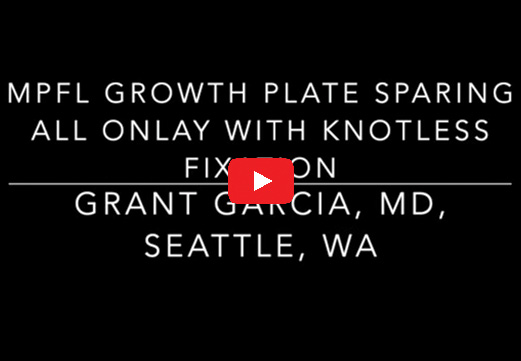
🎥 New Surgical Technique Video: All-Knotless MPFL Reconstruction
Innovation continues to drive better surgery.
In this video, I demonstrate my updated all-onlay MPFL reconstruction technique using the Arthrex 2.6 mm Knotless FiberTak anchors for patellar fixation.
💡 Why this technique?
✅ Smaller patellar tunnels - helping preserve bone and potentially reducing the risk of iatrogenic fracture.
✅ All-knotless fixation - eliminating knot stacks while providing secure graft fixation
✅ Efficient surgical workflow - faster fixation with a streamlined, reproducible technique.
For patients with recurrent patellar instability, the goal is the same: restore stability while minimizing surgical morbidity. Advances in implant technology continue to help us perform less invasive, more anatomic reconstructions without compromising fixation.
🎥 Check out the surgical video and let me know your thoughts on this technique!
🌐 Learn more about MPFL reconstruction:
I always enjoy discussing new techniques and learning from colleagues-feel free to share how you’re currently performing your MPFL reconstructions.
Gulf Islands family boat trip
Post:
Annual Gulf Islands family boat trip in the books! ⚓️🌊☀️
A week packed with exactly what summer should be - family time, beaches, secret little islands, anchoring in beautiful coves, exploring by dinghy, seals, crabs, great food, and plenty of adventures along the way.
This trip was extra special. ❤️ I got to celebrate 17 years of marriage with my best friend and wife, Natasha, and we finished the adventure celebrating our daughter’s birthday. 🎂
These are the weeks that make the best memories. Grateful for the time together, the incredible PNW we get to explore, and another amazing family adventure.
Batteries recharged - literally and figuratively. 😂🔋
Now back home and ready to get back to work. Big week ahead! 💪
Why college athletes need financial literacy now
Post:
🎙️🏈 Why do college athletes need financial literacy now more than ever? 💰📚
NIL opportunities, revenue sharing, and the transfer portal have completely changed the game. Today’s student-athletes aren’t just competing on the field - they’re making financial decisions that can impact the rest of their lives.
🎥 Check out this short clip where Scott Laigo explains why financial education has become an essential part of being a successful college athlete.
But that’s just one part of an incredible conversation.
🎧 In this episode of Sports Doc Talk, we discuss:
💵 NIL vs. revenue sharing
🎓 Financial literacy for college athletes
🔄 The realities of the transfer portal
🏈 Recruiting pressure on young athletes
🩺 Injuries, athlete safety, and long-term health
🚀 Where college athletics is headed next
If you’re a student-athlete, parent, coach, athletic trainer, or sports
medicine professional, this is an episode you won’t want to miss.
🎧 Watch the full episode:
🍎 Apple: https://lnkd.in/d6VHkxqJ
▶️ YouTube: https://lnkd.in/dTNYZcnr
🎵 Spotify: https://lnkd.in/drS-77n5
🎬 Short clip: https://youtube.com/shorts/NbTDzJPNqL8?si=bMVAWpRsRZE6qUiU
🎙️ Featuring Scott Laigo of Student Athlete Advocates
Hosted by Dr. Grant Garcia & William Sanchez
🙏 Sponsored by The Recovery Shop - our trusted source for post - surgical
rehabilitation and DME solutions. For more information, contact Mike
at mikeb@shop-recovery.com
Nutrition 17: The Hidden Calorie Deficit After Surgery
Post:
🚨 Nutrition Series - Video 17: The Hidden Calorie Deficit After Surgery 🚨
One of the biggest nutrition mistakes after surgery?
❌ “I’m not moving much, so I should eat less.”
The opposite is often true.
🔥 Surgery puts your body into a hypermetabolic state. Even while resting, you’re burning extra energy to support:
🩹 Wound healing
🛡️ Immune function
💪 Muscle preservation
🦴 Tissue regeneration
👉 Recovery requires fuel-not calorie restriction.
💡 Prioritize these calories:
🥩 Protein
- Preserves muscle
- Supports collagen production
- Optimizes healing
🥑 Healthy Fats
- Omega-3s help regulate inflammation
- Support cell membrane repair
🍠 Complex Carbohydrates
- Spare muscle from being used as fuel
- Replenish energy for rehab
- Support immune function
🎯 Bottom line:
Healing is energy-dependent. Underfueling after surgery can increase muscle loss, delay wound healing, and slow your return to activity.
Don’t eat less because you’re moving less. Eat smarter because you’re healing more.
🎥 Video 17 below
https://youtube.com/shorts/gM2wGobmndw?feature=share
📲 Follow for more evidence-based nutrition strategies to optimize surgical recovery.
7 weeks out from Lower Trapezius Transfer
Post:
💪🔥 AMAZING 7-WEEK RESULT - LOWER TRAPEZIUS TRANSFER 🔥💪
https://youtube.com/shorts/5CA-50WqvWo?feature=share
Check out this incredible early result just 7 weeks after a lower trapezius tendon transfer! 🤯🙌
This patient came to me for a second opinion after being told his massive rotator cuff tear was unfixable at an outside facility.
When I first saw him, he had:
❌ Minimal strength
❌ Poor shoulder motion
❌ Significant pain and dysfunction
We elected to perform a lower trapezius transfer to help restore his shoulder mechanics and function. 🦾
⏩ FAST FORWARD 7 WEEKS…
✅ FULL motion 🙌
✅ Good early strength 💪
✅ NO pain 🎯
✅ Major improvement in function 🔥
And remember - this is only 7 weeks! 🚀
Lower trapezius transfer can be an excellent option for appropriately selected patients with massive, irreparable rotator cuff tears, especially when the goal is to restore function while preserving the native shoulder. 🦾💥
🎥 Results like this are why having options for an “irreparable” rotator cuff tear matters.
🔗 Learn more about Lower Trapezius Transfer:
Why I scope high energy ankle fractures
Post:
🎙️ Check out our latest Sports Doc Talk Short featuring foot & ankle expert Dr. Anthony Yi!
🎥 Watch here: https://youtube.com/shorts/lLz0e1cG6NM?si=ursV3gEMk0larMoJ
🎬 What you’ll learn:
Why do I scope high-energy ankle fractures?
Dr. Anthony Yi explains why he routinely performs ankle arthroscopy in high-energy ankle fractures. While X-rays reveal the broken bones, they often miss cartilage injuries, loose bodies, and other intra-articular damage that can significantly impact long-term function. Arthroscopy allows these hidden injuries to be identified and treated at the time of fracture fixation, helping restore the joint as completely as possible and potentially improving patient outcomes.
It’s another great example of how treating the **entire injury-not just the fracture-**can make all the difference in recovery.
For the full discussion packed with surgical pearls and expert insights, check out the complete episode!
🌐 Sports Doc Talk https://www.sportsdoctalk.com/
🍎 Apple Podcasts https://lnkd.in/gg_NUdHr
📺 YouTube https://lnkd.in/g3QYNPM7
🎵 Spotify https://lnkd.in/g5SPPRc2
👥 Follow for more:
- Dr. Anthony Yi
- William Sanchez
- Dr. Grant Garcia
💪 *Brought to you by The Recovery Shop*-your trusted source for post-surgical rehabilitation and DME solutions.
For more information, contact Mike at mikeb@shop-recovery.com
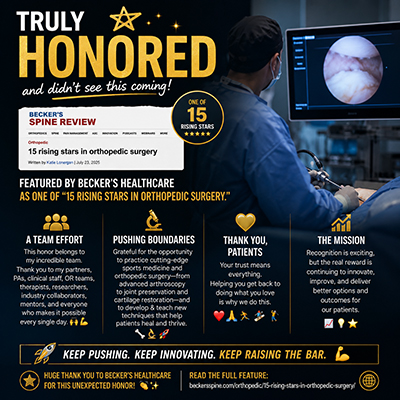
Post:
🔥 TRULY HONORED - AND DEFINITELY DIDN’T SEE THIS ONE COMING! 🔥
Incredibly grateful to be featured by Becker’s Healthcare as one of “15 Rising Stars in Orthopedic Surgery.” 🙏🦴🏆
This recognition was a complete surprise and is truly an honor. ⭐🙏
More than anything, this belongs to the incredible team around me. 💪🙌
THANK YOU to my partners, PAs, clinical staff, OR teams, therapists, researchers, industry collaborators, mentors, and everyone who helps make it possible to push the boundaries of orthopedic care every day. 👏🦴
I feel incredibly fortunate to have the opportunity to practice cutting-edge sports medicine and orthopedic surgery 🔬🦴-from advanced arthroscopy and complex revision surgery to cartilage restoration and joint preservation-and to continue developing and teaching new techniques that can help our patients recover faster, stay active, and get back to doing what they love. 💪🏃♂️🚀
And most importantly, thank you to my patients for trusting me with your care. 🙏❤️ That trust is something I never take for granted.
Recognition is exciting, but the real reward is continuing to innovate, improve, and deliver better options and outcomes for our patients. 💡📈🦴
🚀 Keep pushing. Keep innovating. Keep raising the bar. 💪🔥
Huge thank you to Becker’s Healthcare for this unexpected honor! 🙏🏆
👉 Read the full “15 Rising Stars in Orthopedic Surgery” feature:
https://www.beckersspine.com/orthopedic/15-rising-stars-in-orthopedic-surgery/
Nutrition 16: Creatine Post Op
Post:
🚨 Nutrition Series - Video 16: Creatine After Surgery - Preserving Muscle During Immobilization 🚨
One of the biggest challenges after surgery isn’t just healing-it’s preventing muscle loss.
When you’re immobilized after procedures like ACL reconstruction, knee replacement, Achilles repair, or hip surgery, muscle atrophy begins quickly.
👉 Creatine is one of the few supplements with strong evidence for helping preserve muscle during this period.
💡 What the research shows:
💪 Helps reduce muscle loss
- Attenuates muscle atrophy during periods of immobilization.
🏋️ Supports strength recovery
- Improves strength gains during rehabilitation as activity resumes.
⚡ Provides energy for healing tissues
- Enhances phosphocreatine availability, supporting muscle function and recovery.
✅ Safe after surgery
- Current evidence does not show delayed wound healing with creatine supplementation.
📋 Post-Op Protocol
- 3–5 g creatine monohydrate daily
- Continue throughout the rehabilitation phase
- Especially beneficial after knee, hip, and Achilles surgery
🎯 Bottom line:
Creatine isn’t just for athletes. It may be one of the most effective, evidence-based supplements for preserving lean muscle and improving recovery during the postoperative rehabilitation period.
🎥 Video 16 below
📲 Follow for more evidence-based nutrition strategies to optimize surgical recovery.
MACI Arthro after 50 years old
Post:
🦵✨ AGE IS JUST A NUMBER. YOUR CARTILAGE DOESN’T HAVE TO BE. ✨🦵
One of the most common questions I hear is:
“I’m over 50… am I too old for cartilage restoration?” 🤔
For many active patients, the answer is NO. ✅
This patient underwent MACI Arthro, an innovative minimally invasive arthroscopic cartilage restoration procedure, and their results speak for themselves! 🎉💪
🧬 MACI Arthro uses your own cartilage cells to restore damaged cartilage while preserving your native knee. By combining advanced biologic technology with an arthroscopic approach, we’re helping patients recover faster and get back to the activities they love. It represents one of the latest advances in cartilage preservation surgery.
🏃♂️🚴♀️⛷️ Whether you’re in your 30s, 50s, the birthdate on your driver’s license isn’t what determines if you’re a candidate. Activity level, overall knee health, alignment, meniscus function, and the cartilage defect itself are often much more important than age alone. 💥
Nothing is more rewarding than seeing patients return to an active lifestyle without giving up on the knee they were born with. 🙌
🎥 Watch this inspiring patient testimonial and learn more about MACI Arthro here: