

 Book An Appointment


Dr. Garcia demonstrates the new cuffmend rotator cuff augmentation technique.
Dr. Garcia specializes in complex knee, shoulder and elbow sports surgeries. He has prepared a number of surgical videos below to help patients better understand their procedures. He is frequently updating his surgical video database so check back soon for further updates.
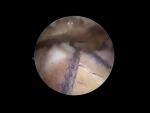
This video features Dr. Grant Garcia demonstrating the innovative CuffMend™ Rotator Cuff Augmentation technique. This procedure is designed for patients with thinning, partial-thickness, or fragile full-thickness rotator cuff tears where the native tendon tissue requires structural reinforcement to improve healing rates and reduce the risk of re-tearing.
Rather than just bridging a gap, this technique overlays and anchors a biologic dermal graft to mechanically reinforce the repaired tendon.
The procedure is outlined through the following key surgical steps:
- Rotator Cuff Repair & Footprint Preparation: Dr. Garcia first performs a standard arthroscopic repair of the underlying rotator cuff tear, securing the tendon back down to the greater tuberosity of the humerus using standard suture anchors. The upper surface of the repaired tendon and the adjacent bone are prepared to create a clean, stable environment for graft placement.
- Graft Sizing and Delivery: Using a specialized measuring guide, the dimensions of the required augmentation zone are determined. The CuffMend graft (a sterile dermal allograft) is prepped on the back table. It is then folded or rolled into a low-profile configuration and delivered directly into the subacromial space through a standard arthroscopic cannula.
- Tissue Placement & Spreading: Once inside the joint, the graft is unfolded and precisely flattened over the top of the repaired rotator cuff tendon. Dr. Garcia ensures it completely blankets the vulnerable transition zone where the tendon meets the bone.
- Suture Anchor Fixation (Augmentation): To secure the graft without introducing high-profile knots that could cause subacromial impingement, Dr. Garcia utilizes low-profile, knotless anchors or specialized fixation tacks. These are driven through the graft and into the underlying bone laterally, while medial sutures are passed through both the graft and the native tendon to create a unified, compressed tissue construct.
The final visual inspection confirms that the graft lies perfectly flat, acting as a supportive structural canopy over the rotator cuff repair. This biomechanically shields the healing tendon from stress, bolstering the overall thickness and strength of the tissue while promoting cellular infiltration for long-term biological remodeling.