

 Book An Appointment


Dr. Garcia demonstrates his advanced technique for “over the top” rotator cuff repair with ...
Dr. Garcia specializes in complex knee, shoulder and elbow sports surgeries. He has prepared a number of surgical videos below to help patients better understand their procedures. He is frequently updating his surgical video database so check back soon for further updates.
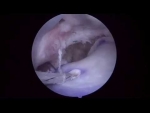

In this advanced surgical video, Dr. Grant Garcia demonstrates his "over-the-top" rotator cuff repair technique following a Superior Capsular Reconstruction (SCR). The patient has a history of three failed rotator cuff surgeries over the last four years, resulting in a complex joint environment with multiple old sutures and anchors causing discomfort.
While a traditional SCR involves repairing the native tissue directly to the dermal allograft patch, this patient’s infraspinatus tendon possesses enough mobility to be brought completely over the top of the patch for an overlaid, double-layered reconstruction.
The demonstration details the following critical steps of the procedure:
- Suture Passing through the Native Cuff: Before securing the lateral row of the SCR patch, Dr. Garcia utilizes the heavy FiberTapes from the medial glenoid anchors to incorporate the native tissue. Using a Scorpion suture passer, he threads the posterior FiberTapes and a secondary stay stitch through the posterior rotator cuff tissue in a horizontal mattress pattern. He then passes the interconnected anterior FiberTapes through the front of the cuff.
- SpeedBridge Construct Over the Patch: By leaving the FiberTapes linked, the surgeon can seamlessly transition into an arthroscopic SpeedBridge configuration. This allows the native rotator cuff to be compressed directly over the top of the underlying SCR patch, maximizing tissue-to-patch contact.
- Lateral Row SwivelLock Placement: The anterior-lateral row is tensioned and locked into the bone using a 4.75 mm SwivelLock anchor. Because the over-the-top cuff repair naturally presses the patch down, there are no loose edges or "dog-ears" on the graft. A second posterior-lateral SwivelLock anchor is placed using crossed strands (one anterior-medial tape and one posterior-medial tape) to complete a stable, crisscross transosseous-equivalent footprint.
- Stay Suture Compression: To augment the fixation, the remaining limbs of the initial stay sutures are pulled tight and tied using a knot pusher. This step applies specialized point compression to tightly marry the overlapping layers of the native cuff and the dermal graft.
- Rotator Interval Integration: To close the anterior gap, Dr. Garcia utilizes a stay suture left over from a previous upper subscapularis repair. He passes this suture through both the SCR patch and the superior edge of the subscapularis tendon using the Scorpion passer, effectively bridging the rotator interval. This is sequentially secured with alternating half-hitches under high tension.
At the end of the operation, Dr. Garcia uses an arthroscopic probe to test the structural integrity of the layered construct. He then releases arm traction and manually applies an upward force to the humeral head, confirming that the combination of the SCR patch and the over-the-top cuff repair completely blocks superior migration and restores joint stability.