

 Book An Appointment



Dr. Garcia demonstrates his advanced arthroscopic technique for snapping scapula syndrome.
Dr. Garcia specializes in complex knee, shoulder and elbow sports surgeries. He has prepared a number of surgical videos below to help patients better understand their procedures. He is frequently updating his surgical video database so check back soon for further updates.
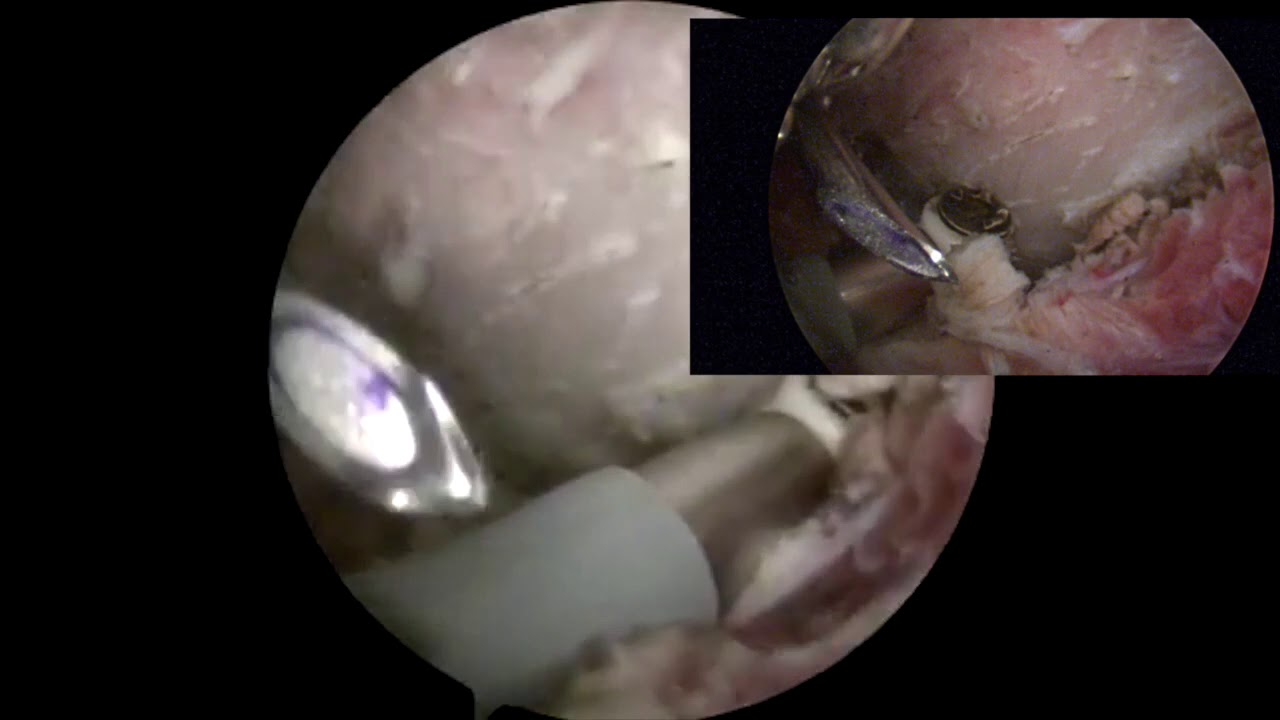

In this video, Dr. Grant Garcia demonstrates his advanced arthroscopic technique for treating snapping scapula syndrome via a scapulothoracic bursectomy and a superior-medial angle bone resection. This procedure is designed to alleviate painful catching, popping, or snapping of the shoulder blade against the ribcage by removing inflamed bursa tissue and shaving down the prominent bony corner of the scapula.
The video highlights the following procedural stages:
- Patient Positioning and Surface Anatomy Mapping: The patient is placed in the prone (face down) position. Dr. Garcia maps out the patient's anatomy on the skin, drawing the border of the scapula and the scapular spine, alongside the exact target zone for the bone resection.
- Portal Placement & Bursectomy: An inferior portal is established roughly 3 centimeters from the medial scapular border and 4 centimeters down. A spinal needle is inserted to localize the scapulothoracic space, followed by a 5.5 mm working cannula. Dr. Garcia uses an arthroscopic shaver to perform a bursectomy, clearing away the chronically inflamed bursa tissue causing the bursitis.
- Tissue Elevation and Visualization: Shifting focus to the superior-medial angle of the bone, the surgeon carefully uses a combination of radiofrequency (RF) ablation and a shaver to elevate the attachments of the serratus anterior and subscapularis muscles off the back of the scapula. He maintains strict care to preserve the surrounding periosteum to safeguard muscle re-anchoring during recovery.
- Bony Resection (Superior-Medial Angle): Viewing from the inferior portal, a spinal needle is left in place percutaneously as a continuous visual guide for orientation. Dr. Garcia uses a 5.5 mm bone cutter and a heavy-duty rounded burr to shave down the bone. The target resection is typically 1 to 2 centimeters from superior-to-inferior, and about 3 centimeters from medial-to-lateral. The burr is critical here because the scapular bone becomes significantly harder and denser as it approaches the scapular spine.
- Fluoroscopic Confirmation and Final Smoothing: Because working in the scapulothoracic space can be highly disorienting, Dr. Garcia utilizes intraoperative fluoroscopy (X-ray imaging) to dynamically verify the depth and symmetry of the bone removal.
After checking the X-rays, any remaining lateral bone spikes or sharp ridges are smoothed down with the rounded burr to prevent any edge catching. The final check ensures a smooth, clear space that allows the shoulder blade to glide seamlessly over the thoracic ribs without further friction or snapping.