

 Book An Appointment



Complex anterior meniscus repair
Dr. Garcia specializes in complex knee, shoulder and elbow sports surgeries. He has prepared a number of surgical videos below to help patients better understand their procedures. He is frequently updating his surgical video database so check back soon for further updates.
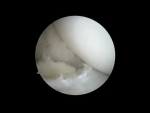
This video, titled "Complex anterior meniscus repair," highlights an arthroscopic technique to treat a combined meniscal injury in a young, active patient. The patient has an anterior vertical capsular tear coexisting with a partial radial tear (running perpendicular to the bone) at the anterior horn of the meniscus, involving about half the thickness of the tissue.
To stabilize this tricky combination and prevent the radial tear from spreading, the surgeon utilizes an inside-out rip-stop suturing technique.
The core steps of the procedure shown in the video include:
- Identifying the Injury: The surgeon locates the vertical capsular tear (which matched up with significant signaling on the patient's preoperative MRI) along with the nearby partial radial tear at the front (anterior horn) of the meniscus.
- Placing the Suture Network: Using an inside-out technique, the surgeon passes three distinct stitches through the tissue. Two vertical mattress stitches are placed first to structurally pull the vertical capsular tear back into position.
- The "Rip-Stop" Technique: A third stitch is placed strategically to create a horizontal structural barrier—acting exactly like a "rip-stop" thread in heavy-duty fabric. This stitch re-routes mechanical forces so that normal knee movement won't pull apart the radial fibers or cause the radial tear to propagate further into the meniscus body.
- Tying the Knots: The long suture limbs are guided out through a small accessory incision on the outside of the knee. With the leg held in full extension, the sutures are tied securely over the joint capsule, compressing both tear patterns simultaneously.
- Biologic Augmentation: Once probing confirms that the meniscus is stable and the radial tear is tightly anchored, the surgeon microfractures the femoral notch. Making these controlled, tiny bone punctures releases bone marrow elements and stem cells into the joint fluid, providing a powerful biological boost to maximize the meniscus's healing rate.