

 Book An Appointment



ACL Repair 2025 Update
Dr. Garcia specializes in complex knee, shoulder and elbow sports surgeries. He has prepared a number of surgical videos below to help patients better understand their procedures. He is frequently updating his surgical video database so check back soon for further updates.
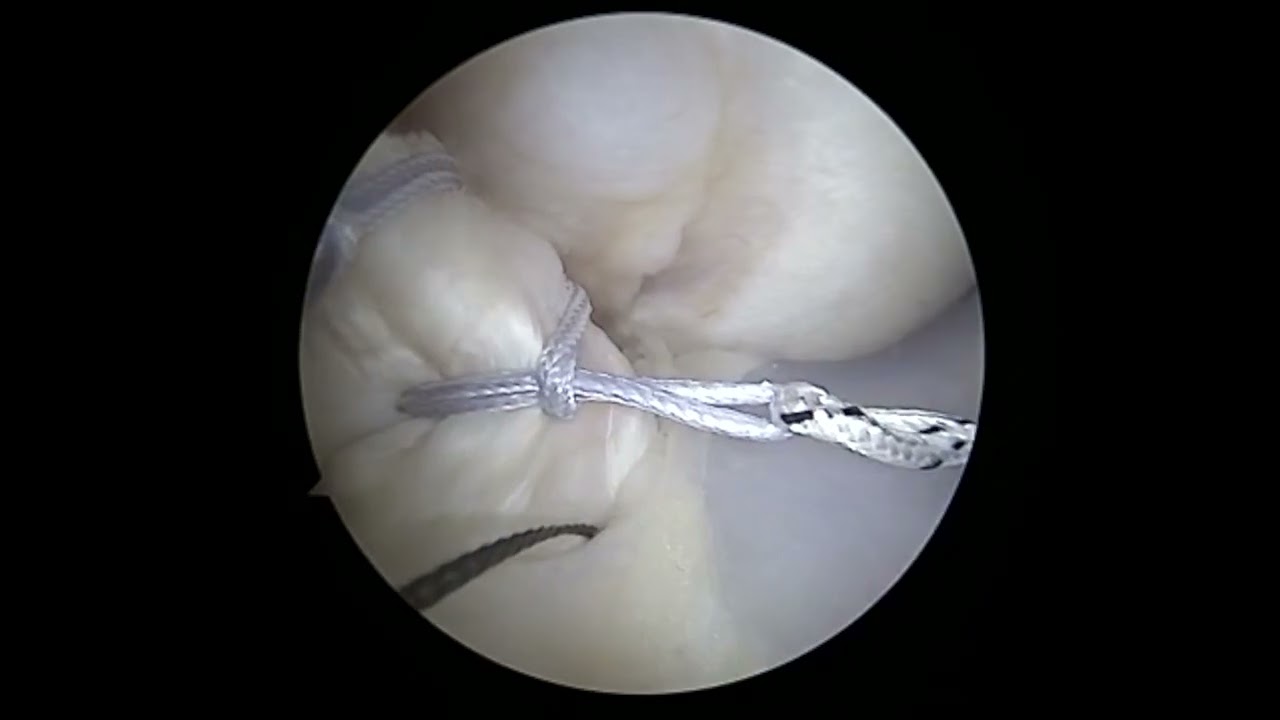

In this surgical video, Dr. Grant H. Garcia demonstrates his updated technique for a primary ACL repair utilizing a TightRope fixation system and fiber rings.
The procedure is carefully executed through several specialized steps:
- Patient Selection & Site Preparation: The patient presents with a proximal ACL tear (classified as a Sherman type 1). Because the tissue is of good quality and has a favorable tear pattern, Dr. Garcia proceeds with a repair rather than a full reconstruction. He debrides the tip of the torn ligament and the femoral footprint, using a ball rasp to clear and irritate the area. A power pick is then used to create small microfracture holes, which encourage the egress of healing stem cells.
- Tunnel Drilling & Suture Management: A Passport cannula is immediately placed medially to keep the workspace organized and prevent suture tangling. A 4.5 mm spade tip drill creates the femoral tunnel to house the button and the TightRope fixation. A bull guide with a 2.4 mm cannulated pin is used to pull a passing wire out of the lateral portal.
- Suture Passing & Bundle Capture: Using a shoulder Scorpion device, Dr. Garcia passes a 35 mm fiber ring through the bulky tissue. He approaches from the lateral direction to easily capture both the anteromedial (AM) and posterolateral (PL) bundles of the native ACL. This process is repeated with a second fiber ring, and both are sequentially linked directly into the TightRope button assembly.
- Graft Inversion & Internal Bracing: The button and associated sutures are pulled up into the femoral tunnel. Dr. Garcia holds onto the fiber tapes manually to prevent the button from getting pulled directly into the iliotibial (IT) band. The internal brace is then passed down through the tibial tunnel.
- Final Tensioning & Fixation: Final fixation of the internal brace is performed with a SwivelLock anchor while the leg is held at 0 degrees of extension, ensuring the knee is not over-constrained. Once secure, a Lachman test is performed on the table to verify excellent stability and proper tensioning of the repaired ligament.